News
Doomsday Clock Set at 85 Seconds to Midnight as Climate and AI Risks Intensify
Jan
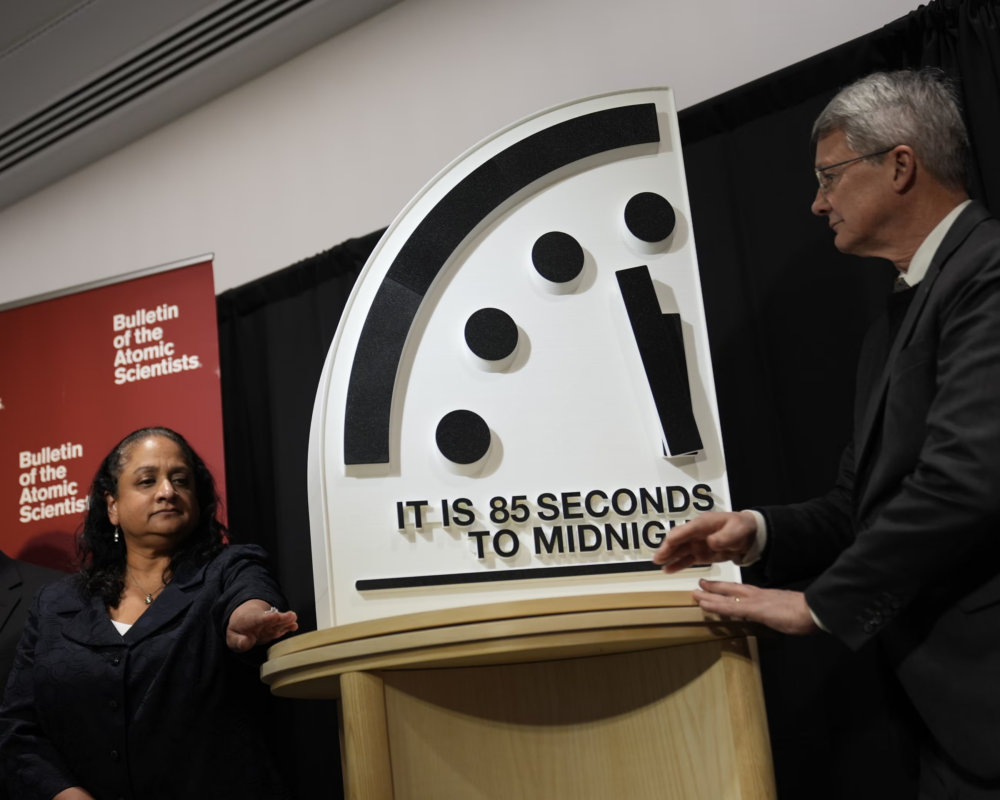
The world is edging closer to catastrophe as major global powers grow more confrontational and inward-looking, a leading science-focused advocacy group warned on Tuesday while moving its symbolic Doomsday Clock to just 85 seconds before midnight — the closest it has ever been to signaling potential global collapse.
The announcement came from the Bulletin of the Atomic Scientists, whose members held a preliminary demonstration on Friday before formally unveiling their updated assessment. The annual reset of the clock is meant to represent how near humanity is to self-inflicted disaster, based on a range of geopolitical, technological and environmental threats.
Rising Global Tensions and Expanding Risks
In its latest statement, the group pointed to what it described as an increasingly dangerous international climate, driven by growing aggression and nationalism among major powers including Russia, China and the United States. According to the Bulletin, this shift is eroding decades of diplomatic progress and weakening the international cooperation needed to manage existential risks.
Last year, the clock stood at 89 seconds to midnight. Since then, the group says, “hard-won global understandings are collapsing,” giving way to a more competitive, zero-sum approach to global leadership — one that heightens the chances of conflict rather than cooperation.
Nuclear Flashpoints and Escalating Conflicts
One of the most pressing concerns remains the threat of nuclear war. The scientists cited ongoing and recent geopolitical crises involving nuclear-armed or nuclear-capable nations, including the war between Russia and Ukraine, renewed tensions between India and Pakistan earlier this year, and growing uncertainty over Iran’s nuclear capabilities following military strikes by the U.S. and Israel last summer.
Daniel Holz, chair of the group’s Science and Security Board, emphasized the dangers of a fragmented world order. “If the world splinters into an us-versus-them, zero-sum mindset,” he said, “the likelihood increases that everyone ultimately loses.”
Climate, Biotechnology and AI in the Spotlight
Beyond military threats, the Bulletin highlighted the accelerating impacts of climate change, including worsening droughts, extreme heatwaves and catastrophic flooding around the world. The group criticized what it sees as a lack of meaningful global action, noting that many countries continue to fall short of commitments needed to curb global warming.
The scientists also raised alarms about the rapid expansion of artificial intelligence and biotechnology, warning that both fields are advancing faster than the safeguards designed to regulate them. The misuse of AI, particularly in military, surveillance and misinformation contexts, was singled out as a growing risk, especially in the absence of strong international oversight.
A Symbol With a Long History
The Doomsday Clock was first introduced in 1947 as a visual metaphor to represent the likelihood of humanity triggering its own destruction. At the height of the Cold War, it moved closer to midnight, before retreating as global tensions eased. In the early 1990s, following the collapse of the Soviet Union, the clock was set as far back as 17 minutes to midnight — its most optimistic position.
In recent years, however, the Bulletin has shifted from measuring time in minutes to counting down in seconds, reflecting what it describes as the rapid pace of global change and mounting risks.
A Warning — and a Call to Action
Despite the grim outlook, the group stressed that the clock is not meant to predict the future, but to serve as a warning. The scientists said the hands can still be pushed back if world leaders and nations commit to cooperation, diplomacy and concrete action to address the most serious threats facing humanity.
“The future is not fixed,” the group said, emphasizing that collective effort, renewed trust and responsible leadership remain the most powerful tools for steering the world away from the brink.
