
News
Mendoza, a Legendary Fourth-Down Decision and Indiana’s Historic Victory
Jan
MIAMI GARDENS, Fla. — Indiana looked ready to play it safe.
With a three-point lead and 9:27 left in the College Football Playoff National Championship Game, the Hoosiers began sending out their field-goal unit. From inside 40 yards, kicker Nico Radicic had been nearly flawless all season. Taking the points would have forced Miami to drive the length of the field just to grab its first lead. It was the logical, conservative choice.
But head coach Curt Cignetti wasn’t interested in logic. He was interested in belief.
“Get off the field! We’re going for it!” offensive tackle Carter Smith recalled Cignetti shouting.
In that instant, a routine decision became a defining moment — not just for the game, but for a program that had spent decades on the outside of college football’s elite.
A Coach Who Refused to Play Small
Cignetti had arrived at Indiana preaching a simple but radical idea: the Hoosiers didn’t have to settle for respectability. They could chase championships. On fourth-and-4, with a title on the line, he put that philosophy into action.
Smith, standing in the huddle, felt the weight of the moment. “Don’t lie to me now, coach,” he thought. “Let’s go.”
What followed was chaos at first — Indiana burned its second timeout in a one-score game as the sideline scrambled. But when the play was finally called, the message was crystal clear: this team was betting on itself.
Mendoza’s Moment
Quarterback Fernando Mendoza, the Heisman Trophy winner playing for a national championship in his hometown, lined up for a play Indiana had practiced all week. It was his first designed draw of the night.
The result was unforgettable.
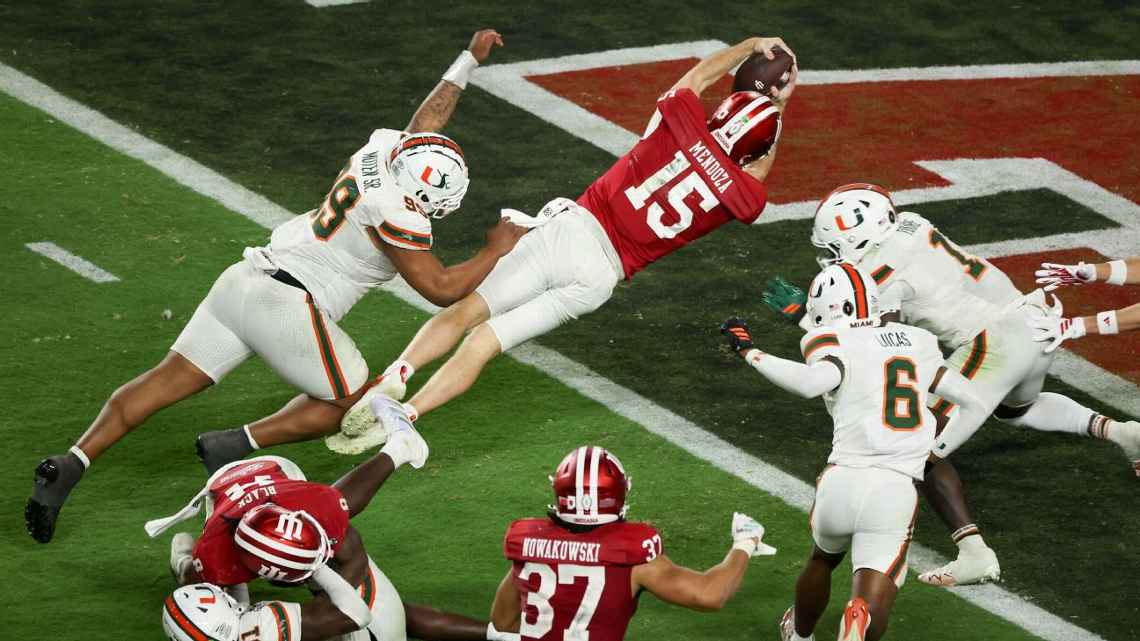
Mendoza burst through the line, picked up the first down, then kept driving. He bounced off a linebacker, churned his legs, and pushed across the goal line for a 12-yard touchdown that sent the Indiana sideline into a frenzy.
The score didn’t mathematically seal the game, but it changed everything. The Hoosiers now had breathing room, momentum and belief on their side. They would go on to win 27–21, securing the first national championship in program history.
“We always tell ourselves to bet on ourselves,” Mendoza said afterward. “When Coach Cignetti and Coach Shanahan called that play, we knew this was the moment to prove it — on the biggest stage.”
Trust Over Trends
If Indiana had one statistical blemish during its perfect season, it was fourth-down efficiency. The Hoosiers converted only half of their attempts during the year and hadn’t even tried one in their first two playoff games because they dominated Alabama and Oregon so thoroughly.
But Cignetti wasn’t thinking about percentages. He was thinking about players.
“He’s always had our backs,” center Pat Coogan said.
The coaching staff had spent nearly an hour earlier in the week reviewing that exact situation: third- or fourth-and-medium in the red zone. Offensive coordinator Mike Shanahan explained that Mendoza had the freedom to throw if Miami blitzed, but the read told him to keep it.
“We put the ball in our best player’s hands,” Shanahan said. “And he made a hell of a play.”
Winning in the Trenches
Up front, the offensive line executed perfectly. Smith had a one-on-one assignment against Miami star defensive end Rueben Bain Jr. His job was to force Bain outside and create a lane.
“He tried to cut inside,” Smith said. “I stayed on him, pushed him wide, and Fernando slipped through. Then I saw the pile forming and thought, ‘Go push it.’ But I didn’t even get there — he did it himself.”
Mendoza bounced off linebacker Wesley Bissainthe and powered into the end zone, turning a risky call into a championship highlight.
Miami Knew It Was Coming
The most frustrating part for the Hurricanes? They had prepared for the play.
Defensive coordinator Corey Hetherman admitted the draw was Indiana’s “go-to” call from that formation. He said he wished he had used one of Miami’s remaining timeouts to reset the defense.
“We knew what was coming,” Hetherman said. “It wasn’t a secret.”
But knowing and stopping are two different things.
The Final Stand
Mendoza’s touchdown reignited Indiana’s defense, which had built a 10–0 halftime lead before giving up two quick Miami scores in the third quarter. Now back up by double digits, the Hoosiers locked in.
Miami had one last chance to steal the game. With 44 seconds left, quarterback Carson Beck launched a deep pass downfield — and Indiana’s Jamari Sharpe stepped in front of it for the interception that sealed the title.
“That’s Coach Cig’s mentality,” defensive coordinator Bryant Haines said. “We don’t play not to lose. We play to go take it.”
A Locker Room Full of History
As cigar smoke drifted through the locker room and music blared, the magnitude of the moment hit the offensive line in one corner of the room.
Smith thought back to 2022, when he nearly transferred after two losing seasons. Coogan reflected on standing in the same stadium a year earlier — then with Notre Dame — and falling short of a championship. Zen Michalski remembered the doubts he heard when he transferred from Ohio State to Indiana.
“People told me, ‘You’re going to Indiana. You might not win many games,’” Michalski said. “Well — 16–0. National champions.”
When asked what he would remember most from a season full of unforgettable moments, Michalski didn’t hesitate.
“That fourth-and-4 by Fernando.”
Smith agreed.
“That play is burned into my brain,” he said. “I don’t think I’ll ever forget it.”
A Snapshot in Time
In a sport dominated by blue-blood programs, five-star recruits and massive budgets, Indiana’s championship run felt almost defiant. And in many ways, it was all captured in a single decision — a coach waving off the field-goal unit, a quarterback trusting his legs, and a team choosing belief over safety.
Fourth-and-4 didn’t just win a game.
It changed a program’s history.
